
Atanas Marinov
About
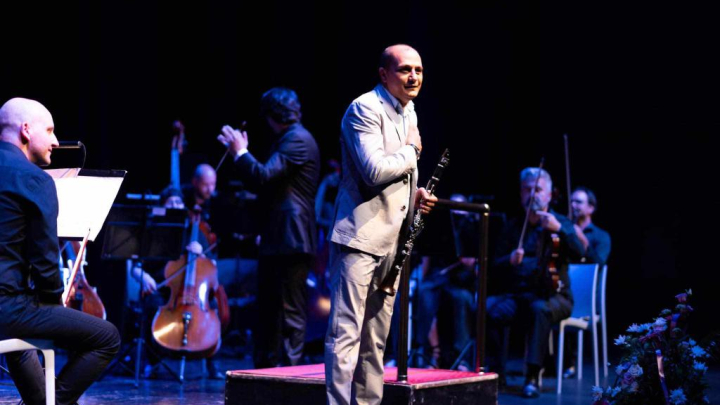
Atanas Marinov is an exceptional clarinetist who impresses with his mastery and dedication to music, as a fourth-generation musician in his family. Born in 1989 in Sofia, Bulgaria, he grew up in an environment rich in music and culture, which shaped his love for classical music and his determination to excel in this art.
Education and Professional Development
Marinov began his musical education in Bulgaria but continued his studies on an international level, earning two Master’s degrees from some of the most prestigious music academies in Europe—the Haute École de Musique in Lausanne and the Zürcher Hochschule der Künste in Zurich. His education there not only enriched him with technical skills but also provided him with the opportunity to immerse himself in the global music scene, meeting and working with renowned teachers and performers.
Recognition and Awards
Marinov is the recipient of numerous awards from prestigious international competitions, which attest to his exceptional talent and hard work. Among these are the Austrian Soloist Competition in Vienna, the Grand Prize Virtuoso in London, the International Wind Competition in Riddes, Switzerland, as well as competitions in Macedonia and Bulgaria. These awards not only establish his name in the musical community but also place him among the best young musicians of his generation.
Career and Performances
Atanas Marinov is a frequent guest at international music festivals such as Puplinge Classique, Verbier Festival, Cully Classique, Forum Wallis, Sofia Music Weeks, and Eurochestries. He has performed in some of the world’s most prestigious concert halls, including Lotte Concert Hall, Royal Albert Hall in London, Smetana Hall in Prague, Zurich Tonhalle Concert Hall, Tonhalle Saint Gallen, Bulgaria Hall in Sofia, and many others.
Orchestral Career
Marinov’s professional orchestral career began in 2013 with a probationary period at the National Opera in Sofia, where he quickly established himself as a promising young musician. He then became the second clarinetist with the Academy Symphony Orchestra in 2014. In 2016, he was appointed principal clarinetist of the Genesis Orchestra, after which he continued his career in South Korea, where he worked with the Daejeon Philharmonic Orchestra as the first solo clarinetist. In South Korea, he made a significant contribution to the musical life, participating in various concerts and events, which solidified his reputation as a talented and dedicated performer.
Master Classes and Pedagogical Activities
Over the years, Atanas Marinov has participated in numerous master classes led by world-renowned clarinetists such as Dmitry Rasul Kareyev, Karl Leister, Milan Rericha, Fabio Di Casola, Romain Guyot, Gabor Varga, Harri Mäki, and Art Rozeboom. These opportunities allowed him to refine his skills, exchange ideas with leading musicians, and draw inspiration from various musical traditions and styles.
Notable Projects and Recognition in Bulgaria
In 2023, Atanas Marinov was invited by conductor Yordan Kamdzhalov to participate in a national tour with the Pleven Philharmonic. Together, they performed over 100 concerts in various cities across Bulgaria, reaching a wide audience and promoting classical music to the Bulgarian public. The success of this project led to Marinov’s nomination for the prestigious „Musician of the Year 2024“ award in Bulgaria—a recognition of his contribution to the musical arts in the country.
Conclusion
Atanas Marinov is not only a talented musician but also an inspiring individual who continually strives for excellence in his profession. His career is an example of how with hard work, talent, and passion, great heights can be reached in the world of music. With his continued participation in prestigious projects and concerts around the world, Marinov will undoubtedly remain an important figure in the contemporary music scene.
Teaching Style
Classical
Characteristics: Known for its rich, smooth tone in orchestras, chamber groups, and solo performances.
Subgenres: Baroque, Classical, Romantic, and Contemporary.
Notable Composers: Mozart (Clarinet Concerto in A major), Brahms (Clarinet Quintet), Weber (Clarinet Concertos No. 1 and 2).
Playing Style: Emphasis on controlled tone, expressive dynamics, and technical precision.
Jazz
Characteristics: Central in early jazz (New Orleans and Dixieland) and swing bands, known for its bright, lively sound.
Subgenres: Dixieland, Swing, Bebop.
Notable Musicians: Benny Goodman ("King of Swing"), Sidney Bechet, Artie Shaw.
Playing Style: Includes improvisation, swung rhythms, and expressive vibrato; focuses on flexibility and creativity in phrasing
Klezmer
Characteristics: Traditional Jewish music known for its expressive, often joyful, and sometimes melancholic sound.
Common in: Eastern European Jewish folk music, but also widely appreciated in Western classical and world music circles.
Notable Musicians: Naftule Brandwein, David Krakauer.
Playing Style: Use of ornamentation, bends, slides, and soulful vibrato; it mimics the human voice and has an emotive, sometimes playful, sound.
Contemporary and Avant-Garde
Characteristics: Experimental use of extended techniques, including multiphonics, microtones, and unconventional timbres.
Notable Composers: Luciano Berio, Elliott Carter, Pierre Boulez.
Playing Style: Often requires advanced technical skill and willingness to experiment with new sounds; frequently expl
ores new compositional forms and ideas.
Latin and World Music
Characteristics: Often appears in Latin, Balkan, Greek, and Turkish music for its warm, vibrant sound.
Notable Styles: Balkan folk, Turkish clarinet, Brazilian chorinho.
Notable Musicians: Anat Cohen (Brazilian jazz and chorinho), Hüsnü Senlendirici (Turkish clarinet).
Playing Style: Characterized by rhythmic drive, heavy ornamentation, and often bright, powerful tone to match the high-energy ensemble sound.
Curriculum
Traditional/Classical Method
Method Focus: Foundation in classical technique, tone production, reading, and articulation.
Recommended Texts:
Beginners:
Rubank Elementary Method for Clarinet – Great for foundational skills, includes exercises, scales, and short pieces.
Essential Elements for Band, Book 1 – Well-structured for young beginners, covering basics progressively.
Intermediate:
Rubank Intermediate Method – Adds complexity with intermediate-level exercises and techniques.
Klose Method for Clarinet – A comprehensive method with etudes and scales, ideal for strengthening finger technique and control.
Baermann Method for Clarinet, Part 3 – Emphasizes exercises for finger agility and scale mastery.
Advanced:
Baermann Method for Clarinet, Parts 1 & 2 – Intensive technical exercises, ideal for advanced players aiming to master technique.
Rose 32 Etudes for Clarinet – Classical etudes with melodic and technical challenges.
Jeanjean 18 Etudes for Clarinet – Advanced, expressive etudes for more experienced students.
2. Suzuki Method
Method Focus: Emphasizes ear training, learning by listening, and a nurturing approach with a heavy parental involvement.
Recommended Texts:
Suzuki Clarinet School, Volumes 1-3 – Introduces technique and tunes by ear; reading music comes later.
Supplementary Listening Material: Suzuki encourages listening to classical and folk music to build familiarity with sound before reading.
3. Jazz/Improvisation Method
Method Focus: Learning jazz standards, improvisation, ear training, and rhythm.
Recommended Texts:
Beginners:
Aebersold Play-A-Long Series, Volume 1: How to Play Jazz and Improvise – Great for beginners in jazz; offers backing tracks and improvisation exercises.
Essential Elements for Jazz Ensemble – Introduces jazz scales, rhythms, and basic improvisation concepts.
Intermediate/Advanced:
The Jazz Method for Clarinet by John O’Neill – A comprehensive introduction to jazz clarinet, covering techniques, exercises, and standards.
Patterns for Jazz by Jerry Coker – Focuses on patterns for improvisation, with exercises that develop jazz phrasing and harmony.
4. Klezmer Method
Method Focus: Teaches the traditional Jewish folk style, emphasizing emotive playing, ornamentation, and expressive tone.
Recommended Texts:
Klezmer for Clarinet by Avrahm Galper – A book with klezmer tunes, covering techniques specific to klezmer ornamentation.
The Compleat Klezmer by Henry Sapoznik – Offers history, technique, and repertoire to develop a traditional klezmer sound.