
LeeLee Hunter
About
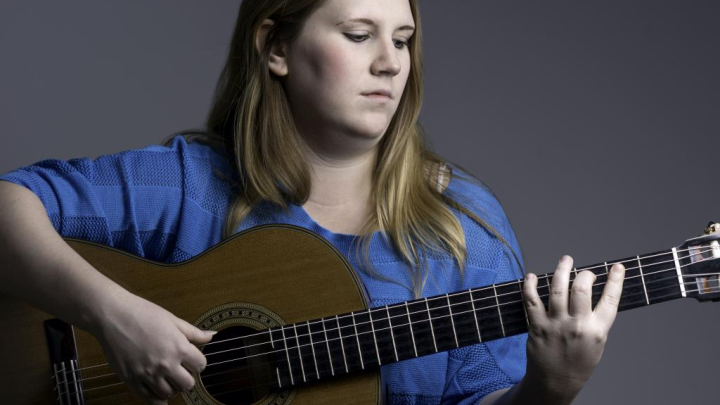
A DC area native, LeeLee Hunter was initially introduced to music, though somewhat reluctantly, through her enrollment in the church choir at the age of four; however, she grew to love it very quickly. Dr. Hunter first experienced the guitar while living in Hong Kong when her third-grade teacher would play for them everyday at the end of school. She began taking lessons while living in Hong Kong and continued when she moved back to Washington DC. Dr. Hunter received her bachelor’s and master’s degrees in guitar performance from the Peabody Institute of the Johns Hopkins University under the guidance of Julian Gray; she received her PhD in Musicology from the University of Arizona where her research focused on 19th century guitar music and early 20th century American music.
Teaching Style
I have had the opportunity to teach in a variety of situations and to interact with students of different ages, races, and backgrounds; through this, I learned that being a successful teacher relies on four fundamental elements: flexibility, communication, passion, and creativity.
Communication is something I stress not only in my classroom teaching, but in my private lessons as well. I firmly believe that open lines of communication are essential both inside and outside of the classroom. While teaching it is important that one be able to clearly transmit the materials, through my private teaching I learned the necessity of being able to relay the information in a variety of ways—while I may understand what I am trying to say, that is not always the case for the student, and it is my responsibility as the teacher to find a way that makes sense to them. I also emphasize the importance of communication outside of the classroom or lesson; keeping open lines of communication between myself and my students allows me to ensure that I am doing everything I can to make learning an enjoyable process for them and if there is something going on that needs to be addressed, I can do so in a timely manner.
Passion and creativity go hand in hand; if you are passionate about what you are teaching, you are more likely to seek out creative and innovative ways to engage your students. A passion for music is something that I credit my teachers for instilling within me and is something I strive to get across to my own students as well. The opportunities I have had to experience many different teaching situations have allowed me to stretch my creativity in ways that I maybe had not previously considered, whether it be through writing new lyrics to Twinkle, Twinkle Little Star with elementary students in the Philippines to coming up with questions for musical jeopardy at a music camp to assisting in the development of a new curriculum for an undergraduate musicology class. One of the most enjoyable things about teaching, for me, is interacting with students from different backgrounds and discovering what I, as a teacher, can learn from each one of them.
Curriculum
Hal Leonard Guitar Method
Aaron Shearer Classical Guitar Method
Guitar for the Small Fry
Credentials & Affiliations
Dr. Hunter has made solo appearances at the Cincinnati Guitar Workshop and with the McLean High School Orchestra in Heitor Villa-Lobos’s “Bachianas Brasileiras.” She has also performed in master-classes with Ken Meyer of Syracuse University; Stanley Yates; Lorenzo Micheli and Matteo Mela of the Italian duo Soloduo; Bruce Holzman of Florida State University; Carlos Perez; Zoran Dukic; Pepe Romero; Judicael Perroy; Margarita Escapra; Sergio Assad; and David Russell. Ms. Hunter has also particapted in multiple competitions including the Guitar Foundation of America International Artists Competition, the Indiana International Guitar Competition, the Guitar Masters International Competition, the Beeston Memorial Competition, the David Russell Bach Prize, and the Sholin Memorial Competition. Ms. Hunter has presented her research on African-American spirituals at the annual meeting of the Society for Christian Scholarship in Music and the Graduate Student Conference at the University of Arizona.