
About
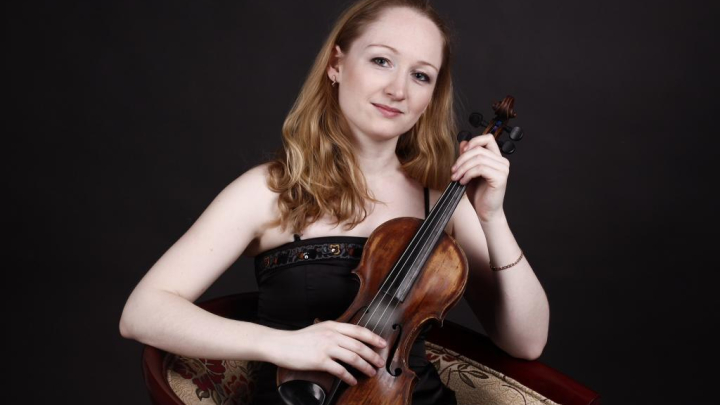
Raisa Ulumbekova was born in Leningrad (today St.Petersburg, Russia). She has received her primary education at the Ohta music center and then an Honors degree at the "Mussorgsky Music State College". The high education Raisa has obtained at the Conservatory "Rimsky-Korsakov" of St.Petersburg in the class of Professor Oleg Shulpyakov, continuing her postgraduate studies at the Wilhelm University of Münster in Germany, where she has received a Master degree in musical performance and a second postgraduate degree as a violin soloist.
She participated in chamber music masterclasses in Weikersheim (Germany), and in masterclasses with Thomas Fueri and Daniel Draganov.
From 2000 to 2005 she held the position of assistant concertmaster at the Opera and Ballet Theater of the St. Petersburg's Conservatory and from 2005 to 2011 she was a violinist of the symphony orchestra of the "State Kapella" in Saint Petersburg. In 2005 she held a tour to perform several concerts as a soloist in South Korea.
In Germany she has collaborated with the following orchestras - "Klassische Philharmonie Bonn", Aachen Opera Theater as second concertmaster, Bochum Symphony Orchestra as second violin soloist, "Kammeroper Köln" as concertmaster.
As a violin teacher she has worked at various music schools in St.Petersburg (Russia) and Germany and at the University of Münster. From 2005 to 2011 she was belonging to the group of professors of the composition faculty of the Conservatory "Rimsky-Korsakov" in St.Petersburg.
Since 2008, Raisa Ulumbekova has been the founder, artistic director and concertmaster of the St. Petersburg Chamber Orchestra "Carpe Diem", with whom she has performed numerous concerts and international tours.
She is currently a violinist in the “ADDA Simfónica” orchestra (Alicante, Spain) and a musician at the German agency of classical artists “Münster Klassik”.
Teaching Style
Raisa´s teaching Style can be named "Russian school". She intends to motivate students to get the best what they can at the moment, to work for the best result, they can achieve, and at the same time, always controls, that the student enjoys the process - this Raisa finds as a fundamental of any kind of teaching. She creates a dialogue with student, asks questions, so that student can find an answer, how to improve this or that, by himself. So except of teaching, how to play violin good enough, she teaches the students, how to practice, to put sense in anything they do, to find their own original style of performing.