
Avery Scott
About
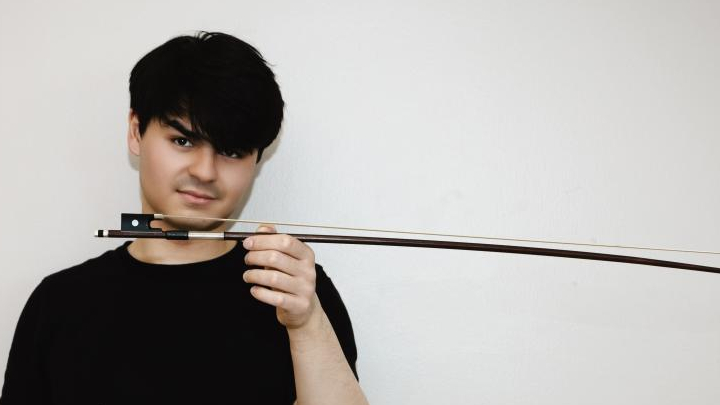
I am a violinist pursuing a Master of Music degree at the Mannes School of Music in the studio of Stefan Jackiw. I earned a Bachelor of Music degree in violin performance from the Boston University School of Music under the tutelage of Klaudia Szlachta and Yuri Mazurkevich. I was named the 2023 Boston University Presser Scholar, and I am a member of the Pi Kappa Lambda honor society; I was also selected as a Teaching Assistant for the Boston Youth Symphony Orchestra’s 2020-2021 season. I have played under the batons of conductors such as James Burton, Jonathan McPhee, Mischa Santora, and Stefan Asbury. Prior to attending Boston University, I performed as Associate Concertmaster of the Long Island Youth Orchestra and the Pierrot Festival Chamber Orchestra, and I was a pre-college guest with the LIU Post Orchestra and the Baroque Orchestra of New Jersey.
I have participated in summer festivals such as the Lake George Music Festival, the Online Solo Strings Intensive, the Berkshire High Peaks Festival, and the Pierrot Chamber Music Festival, where I studied and performed in master classes with Mark Kaplan, Tessa Lark, Giora Schmidt, Peter Zazofsky, Hisaichi Shimura, and Dale Stuckenbruck. My chamber music instructors and mentors have included Alexander Shtarkman, Michael Strauss, Veronica Salas, Maureen Hynes, as well as members of the Boston Symphony Orchestra and the Arneis, Muir, Shanghai, and Emerson Quartets.
Awards received earlier in my career include the Cynthia Platt Scholarship (Baroque Orchestra of New Jersey), the Tilles Scholar prize (Pierrot Chamber Music Festival), and the Rex Chao Memorial Prize for dedication to the study and performance of chamber music (Pierrot Chamber Music Festival). I was a winner of the 2019 Long Island Youth Orchestra Concerto Competition, and my solo performance at a concert of the Baroque Orchestra of New Jersey was praised for its “startling virtuosity” (Sheila Abrams, NJ Arts Maven). My first teachers were Agnes Kwasniewska and Anton Polezhayev.
Teaching Style
Teaching has been foundational part of my musical and educational journey from the very start. I was introduced to the joys of sharing my knowledge with others at a young age, and I soon discovered that helping guide others on their musical journeys was particularly meaningful to me, especially as it provided a chance to pay forward the inspiring teaching that had instilled my own deep love of music. Working as a Teaching Assistant for the Boston Youth Symphony Orchestras (BYSO), as a private violin teacher, and as a substitute for various music schools and summer festivals has only deepened my commitment to teaching as a foundation of my musical life. My love of teaching has also been shaped greatly by perhaps the most significant person in my musical development: my own teacher, Yuri Mazurkevich. The passion, insistent musicality, and radically human approach that make Mr. Mazurkevich’s teaching memorable are hallmarks of what I believe great teaching can be, and I constantly strive to emulate these characteristics.
My educational experiences as both a teacher and as a student, especially my studies with Mr. Mazurkevich, have led me to believe in four key principles that I work to embody in my teaching.
First, my foremost goal as a teacher is to help each student become the best and most authentic musician they can be. I never aim to turn a student into an imitation of myself or of any other musician, but rather to nurture and maximize the student’s unique and individual potential.
Second, I believe that every student is a unique and independent musician. I respect each student’s artistic autonomy, adjust to their style of learning, and prioritize their individual physical comfort. In the realm of musical interpretation, I do not impose my own views but rather give the student the information necessary to make their own musical ideas informed and convincing; in technical matters, I avoid establishing the binary of a right way and a wrong way in favor of exploring approaches that are more or less effective for the student.
Third, I believe that the value of studying technique is inextricably tied to music-making. Whenever possible, I prefer to teach technical concepts within the natural musical context in which they appear; I find such a strategy to be more stimulating and enjoyable since it does not divorce technique from musical goals, and it is remarkably effective at developing productive practice methods. Non-musical exercises such as scales and etudes can be invaluable resources, but I maximize their usefulness by constantly reminding students that technique is a means to the end of musical expression, not a set of skills to be gained for its own sake.
Fourth, I view music as a social activity, and I believe that musical learning experiences are richened by communities where people of diverse backgrounds can interact and learn together as peers. My work with BYSO—an organization known for its trailblazing initiatives to make high-quality musical learning environments accessible to disadvantaged students—illustrated for me the value of spaces that bring students from a broad cross-section of society to collaborate in the joyous and ultimately interconnected experience of learning and making music side-by-side. I was privileged to learn from firsthand experience that the lessons students learn from each other in such environments are just as critical as those that they learn from their instructors.
Fostering student’s authenticity, respecting their individuality, prioritizing musicality, and creating representatively diverse learning spaces are the cornerstones that shape my teaching at every turn. By guiding students according to these key concepts, it is my hope that I can help nurture the generation of musicians, artists, and people that I believe the world needs.
Credentials & Affiliations
Master of Music in Violin Performance, Mannes School of Music (expected May 2026)
Bachelor of Music in Violin Performance, Boston University (May 2024)