
Chromatic Harmonica Chart


Chromatic Harmonica Notes: Complete Note Chart & Layout
Hey everyone!
I was recently at the Lessonface studio and recorded a tutorial for those interested in starting out with the Chromatic Harmonica. You can check it out below:
What Are the Notes on a Chromatic Harmonica?
A chromatic harmonica contains all 12 notes of the Western chromatic scale—including all natural notes, sharps, and flats. Unlike a standard diatonic harmonica, which is locked to a single key, a chromatic harmonica allows you to play in any key on a single instrument by using a slide button on the side.
What Are the Notes on a 12-Hole Chromatic Harmonica in C?
A standard 12-hole chromatic harmonica in the key of C covers three full octaves, ranging from C4 (Middle C) up to C7. Without pressing the slide, it plays the C major scale (all natural notes: C, D, E, F, G, A, B). When you push the slide in, every note is raised by a half-step (semitone), giving you access to all the sharps and flats (C#, D#, F#, G#, A#).
Why Are Some Notes Repeated on a Chromatic Harmonica?
If you look at the layout of a chromatic harmonica, you will notice duplicate notes—most notably C (which appears as both a blow note and a slide-in blow/draw on adjacent holes) and E/F boundary transitions. These repeated notes exist to keep the breath pattern consistent across every octave (Blow = C, E, G; Draw = D, F, A, B) and to make scale patterns identical no matter which octave you are playing in.
Chromatic Harmonica Note Chart and Layout
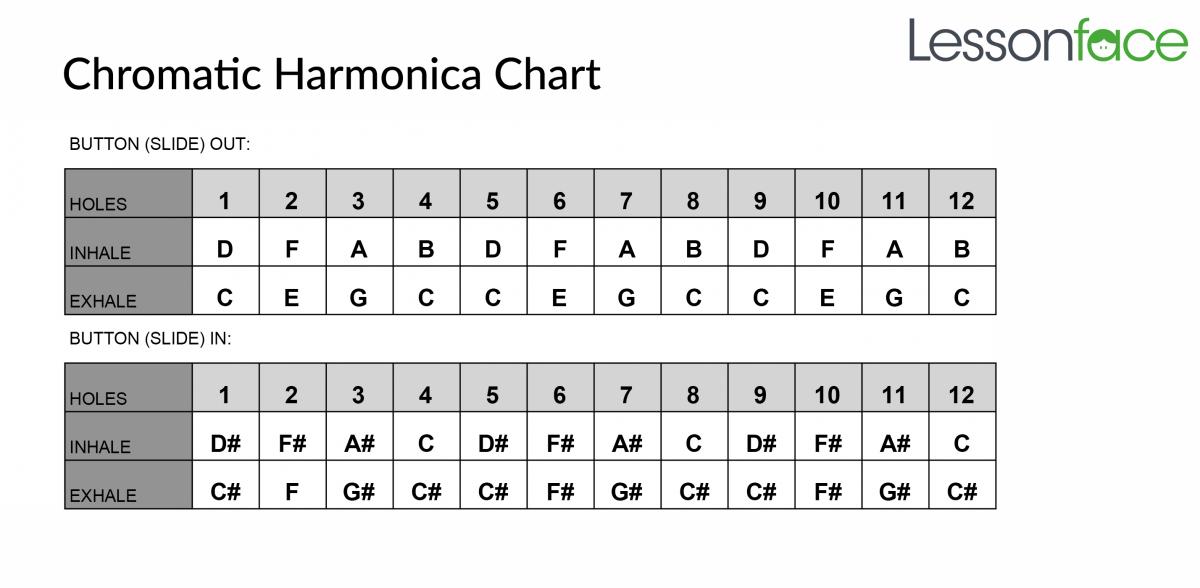
We used this Chromatic Harmonica Chart in the video to show you exactly where the notes are located across the instrument, and you can download it here for free!
How to Read the Chromatic Harmonica Note Chart
The chart displays the holes numbered 1 through 12 from left to right. The top row indicates the notes produced when blowing into the instrument, while the bottom row shows the notes produced when drawing (inhaling) air. Arrows or color coding highlight the difference between playing with the slide out (button open) versus pushing the slide in (button pressed).
What Happens to the Notes When You Press the Chromatic Harmonica Slide?
Pressing the slide button redirects the airflow to a second set of reeds tuned a half-step higher. For example:
- Blowing into Hole 1 with the slide out produces C.
- Blowing into Hole 1 with the slide in produces C#.
- Drawing on Hole 1 with the slide out produces D.
- Drawing on Hole 1 with the slide in produces D#.
How Is a Chromatic Harmonica Note Layout Different From a Diatonic Harmonica?
A standard 10-hole diatonic harmonica uses Richter tuning, which skips certain scale degrees in the lower octave to allow for easy chord strumming in its home key. To get missing chromatic notes on a diatonic, players must use advanced bending techniques. A chromatic harmonica, by contrast, uses a uniform tuning layout across all octaves and uses a physical slide mechanism to access every semitone cleanly without requiring forced reed bends.
How Can You Practice Using a Chromatic Harmonica Note Chart?
To build muscle memory using the chart:
- Start with single notes: Focus on getting clear blow and draw sounds on individual holes without hitting adjacent holes.
- Play the C major scale: Work up and down all three octaves with the slide out.
- Practice half-step shifts: Alternate between slide-out and slide-in on the same hole (e.g., C to C#) to get comfortable with the button action.
- Learn major scales in other keys: Use the chart to locate the necessary sharps or flats for keys like G, D, or F major.
Improve Your Harmonica Technique With Live Lessonface Lessons
Mastering the chromatic harmonica is a rewarding journey! If you want personalized guidance, customized exercises, or feedback on your technique, you can find me at Lessonface.com/Yotam.
Have a good one, and happy practicing!

Start Lessons
Search for your perfect music, language, or arts teacher and start working towards your learning goals.

Start with a Free Trial
Teachers on Lessonface set their own rates and discounts. Participating teachers offer free trials.
Great Teachers, Great Lessons, Guaranteed
Learn more about the greatest universe for online music and arts lessons.

Lessonface Recitals, Open Mics, Masterclasses, and Jams
Welcome students of all ages and skill levels!