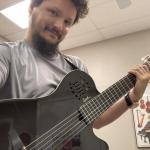
After playing guitar for a long time, and struggling to read music in every presentation that it has come to me (full score, lead sheet, and tabs...thankfully at different times in my journey), there are lots of things that I can now say were hard when they were new. Of course over time, the "new" of it wears off and it's just like anything else we guitarists do. There is however one thing that has caused me a great deal of trouble over the years, as well as every student I have ever taught/seen, and even fellow instructors and long time guitarists alike. I'm talking about..."The Triangle!" That dreaded shape that I'm convinced is of unholy origins; and in particular the triangle that exists between the picking hand, the fretting hand, and the music that you are reading or person/conductor/band leader you may be watching.
Has anyone else notice that...only every guitarist that has ever "guitar-ed" seems to work exclusively to memorize their music? This is why all guitarists are accused of not reading music well. We often get the reputation that we are slow at reading and learning music, never mind the literal "Monty Hall Paradox" that we have to solve before we can even play the first notes of the music. The strangest part of it all is that this problem doesn't cure itself as we continue on in our journey. We all have our ways of dealing with this terrible triangle's existence, and typically it means we find ways to avoid it all together; to the point of making sure that at least one hand, the music, and maybe a conductor/band leader form a nice, single file line.
But fear not fellow "Six Silver Moonbeam Strummers" I have...after much time, toil, and one rather absurd and lucky observation, found a cure for this three sided dilemma. The answer is literally right in front of you. Not kidding, but in order to understand it you need to learn to do two things particularly. Step 1.) Work on recognizing your strings, frets, neck, and guitar body by what you feel. Proprioception is a big, fancy word that means being aware of where any part of your body is in space. You don't actually have to see it to know where it is, or what it's doing because you can feel that. The thing that you cannot feel is the guitar itself as it isn't a part of your body (unless you have the world's most awesome...albeit unusual deformity). You typically can feel that you are touching your guitar, and if you learn to trust your sense of touch, you'll find in a very short amount of time that you don't have to solely rely on just your eyes and ears. Just try some difficult jumps, or chord shapes that give you trouble. Look at them closely at first as you perform this maneuver (literally the same one, so pick just one) over and over again, and as time flies by, start to relax your eyes away from what your hands are doing, looking at it only if you need to fix a mistake. Usually, within 10 minutes or so depending on the difficulty, you'll likely notice that the activity that was causing you a lot of grief in the beginning is now something that you can do without really having to look at it at all.
This brings me to step 2, and this is the one that ties it all together, and it's your peripheral vision. Here is a fun fact; if you position yourself properly, then you can see the music, and both the fretting and picking hands...AT THE SAME TIME!!! Literally all at once! The reason that this is indeed the "Road Less Traveled" for guitarists is because the peripheral vision isn't super clear and things get distorted looking and therefore can't be trusted for something as exact as music, right? Sure, it's a hold over from our survival instincts, I and you both know that. It is, however and in most situations, a little more accurate and useful than we give it credit for. In the exercises mentioned before, start observing what your hands look like in your peripheral vision particularly, and get used to both the sensations that you feel, and what little bit you can actually see of your hands with your eyes on a different fixed point...like your music. Once you do this, assuming you haven't tried this before this point or at any other time, you'll start to notice that you can play very accurately from the page (whatever the presentation of the music) without having to intently focus all your attention on your hands. Once you are used to it, then you can try moving your peripheral gaze back and for between your left and right hands while keeping your eyes glued to music, or another fixed point.
Seriously...30 years and I just realized that I can feel with my hands and see out of the bottom corners of my eyes. If you are reading this, I hope that you all knew about this long before I did (in which a case I have likely earned your laughter). If this has helped someone, then I hope you found it out earlier in your journey than I did. If neither of the before situations are the case, I cannot judge and I'm really glad I could help all the same.
Rock on everybody,
Robert Parrish