
Meet 2025 Teacher of the Year for English & Crochet Erin R.
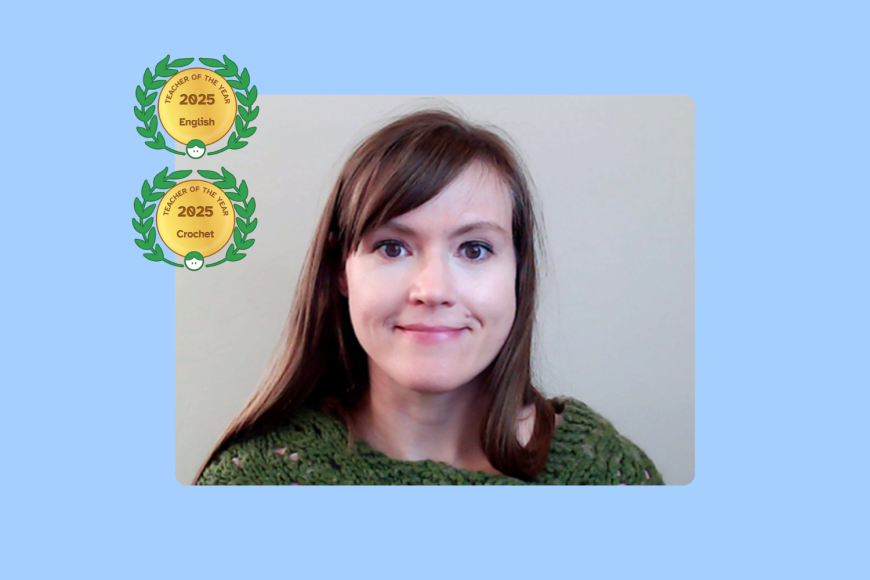

We asked 2025 Lessonface Teacher of the Year in Crochet and English, Erin R., to share insights into her journey as both a creative maker and language educator. In this Q&A, Erin reflects on what first drew her to crochet and to teaching English as a second language, how she designs an organized and supportive online teaching environment, and the skills she believes are most important for long-term growth in both subjects. She also shares the tools and resources she recommends, discusses what she and her students are excited to explore next, and emphasizes curiosity, patience, and connection as the foundation of meaningful learning.
What drew you to learning crochet and teaching English?
In regards to crochet, I loved making items by hand and doing crafts as a child. I love that you can design your own clothes, express your creativity and also share community by crocheting in a group.
For English, I largely wanted to learn to teach English as a Second language to meet and learn about people from all different parts of the world. By learning a second language, it opens us up to understanding new cultures, new art forms, and helps to give us a more expansive view of the world. I recommend that everyone learn a second language if they have the time and interest.
How would you describe your teaching studio?
I share the same workstation for teaching English and Crochet. For crochet lessons, I have an overhead camera so students can see my hands and see stitch demonstrations clearly. For English classes, I have my lessons open on my desktop as well as any lesson material I would like to share with the student during the lesson. I organize my tabs in the order that they are presented in the lesson, for example, having the homework from the previous lesson in the first tab.
How do you ensure you are a good mind frame for teaching in terms of your teaching space?
I always allow myself enough time to organize class and lesson materials in advance before the lesson. For crochet students, I make sure my overhead camera is set up, I have tested the connection, and all the materials and patterns for the student's specific crochet lesson are organized on the screen and on my workstation table.
For English, I make sure all the lesson material tabs are organized in order and I have previously read through lesson material and have written a step by step lesson for the lesson's objective.
If you could gift your students one piece of automatic knowledge or ability about learning English or crochet, what would it be?
For learning English as a second language, it is really important to try to avoid translating as much as possible and try to remember new words and phrases as new vocabulary, similar to how you learn vocabulary in your first language.
For crochet, one of the most important skills is learning to see and count stitches. You can also use stitch markers every 5 or 10 stitches to help keep track of stitches, especially when you are first learning to crochet.
What’s one lasting takeaway you hope your students will carry with them from your teaching, even years from now?
For all my students, I hope they will continue to have curiosity about the subject they are learning and continue to be open to learning new techniques in crochet and new ways of expressing themselves in English.
What are some gear items that you wish all your students had? Are there apps / texts / other resources you often recommend?
For online crochet lessons, I always use and recommend an overhead camera for students. This way, the teacher can see in real time how the student is holding the yarn and if there are any mistakes that are happening in real time. This allows me to immediately help and problem solve with the student.
Ravelry is also a great place to look for new crochet patterns and support independent designers.
For English lessons, listening to TED videos are great for intermediate through advanced level students. You can read along with the text and use a dictionary to look up any new vocabulary. TED videos provide English language learners an interesting way to practice listening and learn new vocabulary.
What’s a skill or idea you’re excited to explore in 2026? How about your students?
Personally, I am looking forward to expanding my crochet design skills and working more on pattern writing. I am looking to create patterns that are easy to understand for beginner through intermediate crochet students and are also fun and inspiring,
My English students have done a great job expanding their communication skills and are comfortable talking about and expressing themselves on a variety of topics including current events, social media trends, and international politics.
My crochet students have done a great job learning amigurumi, learning how to create such projects as an 'ice cream' snail and an amigurumi doughnut and doughnut hole.
Is there anything else you would like to share with potential students about crochet or learning English?
If you want to learn to crochet or learn to speak English like a native, you can absolutely do it! Patience, enthusiasm and clear guidance make both subjects doable and easy to understand.
If you are interested in learning more about Erin or would like to book a lesson with her, please visit her Lessonface profile here.
Also, be sure to check out all of Lessonface’s 2025 Teachers of the Year here!

Start Lessons
Search for your perfect music, language, or arts teacher and start working towards your learning goals.

Start with a Free Trial
Teachers on Lessonface set their own rates and discounts. Participating teachers offer free trials.
Great Teachers, Great Lessons, Guaranteed
Learn more about the greatest universe for online music and arts lessons.
Lessonface Recitals, Open Mics, Masterclasses, and Jams
Welcome students of all ages and skill levels!
Comments
Annette Schmit-Cline
Fri, 08/14/2026 - 5:22pm EDT
Permalink
Customer Inquiry
.