
One Handpainted Braid - Six Different Color Effects
About One Handpainted Braid - Six Different Color Effects
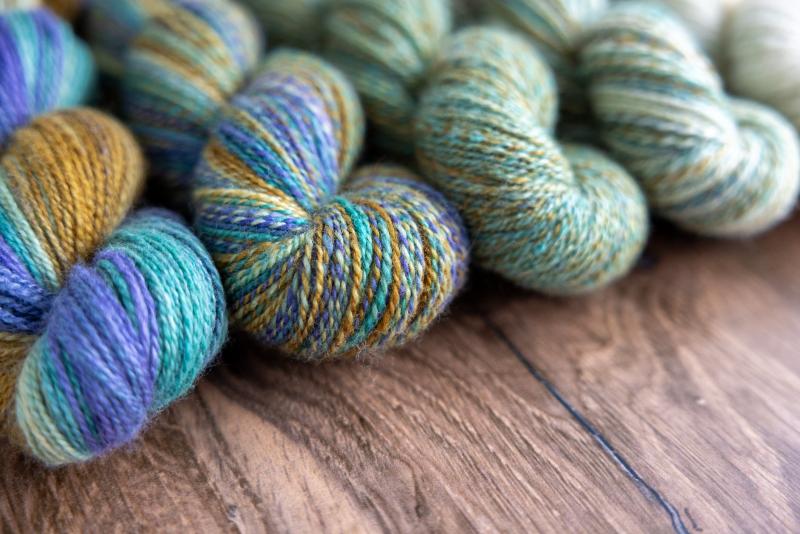
Handpainted braids are wonderful sources of inspiration. Although much of the color work has been done by the dyer, it is up to you, the spinner, to effectively manage the color. In this workshop Kim will explain and demonstrate six color management techniques, which lend your handspun a greater sense of balance, proportion and unity. Using non-traditional methods, Kim will explain and demonstrate how she prepares rovings and rolags on blending boards and handcards. Her methods help to reduce waste, produce the smoothest fiber preparation possible, save time, manage color placement, and create repeatable color effects in handspun yarns.
Unlike an in-person workshop you will not be preparing fibre and spinning during each session. However, if you would like to put what you learn into practice Kim will be presenting two colour management techniques per week. Materials and equipment lists are provided below for those students who wish to practice what they have learned between classes.
An Orientation Session will be held two weeks prior to the first class, on April 16, 7:00 - 8:00 pm Eastern, to answer any questions or concerns you may have regarding your equipment. The Orientation will also be recorded and available until 30 days after the last class.
The capacity for this class is 25 students.
Class Materials
Students will want to provide:
SPINNING:
• Either treadle wheel or e-spinner*. Scotch tension or double drive wheels are recommended. All levels welcome. Spinners should have a solid working knowledge of their wheel and be able to confidently spin a continuous yarn. *Note: If you will be using an e-spinner, remember to bring a battery pack or extension cord.
• Spinning wheel bobbins: Please ensure bobbins are ready to go and cleared of old projects. 3 bobbins are ideal. You will need 1 minimum.
• Leaders: One leader, approximately 2 yards long, for each bobbin.
• Lap cloth (optional): A smooth lap cloth helps to keep fiber tidy and makes for a nicer end product.
• Kate: A Kate or a container outfitted with 2 knitting needles that fit through your bobbins to use for plying.
• Bobbin Winder: You are welcome to use your preferred plying method for this class. We will be spinning for two-ply yarns. I transfer my singles to 2 flanged Leclerc styrene spools (sectional weaving bobbins) before plying. Plastic or cardboard spools are available through most weaving suppliers. I transfer singles from my spinning wheel bobbin to the flanged spools via either a hand cranked weaving bobbin winder or spinning wheel bobbin winder. Alternatively, for the class you can use a ball winder and two cardboard toilet rolls or your own preferred plying method and equipment.
• Other Spinning Wheel Accessories: Please bring any other accessories you normally require such as a threading hook, small side table, etc.
• Wheel maintenance kit specific to your wheel’s requirements such as lubricant, spare drive band, spare brake band, screwdriver, etc.
CARDING:
• Handcards or blending board. My handcards are Schacht 72 pt and my blending board is an Ashford 108 pt
• Two smooth dowel rods, approx. 1/2″- 5/8″diameter. If you purchased a blending board kit equipped with dowels, you will be able to use the dowels from your kit.
• One metal knitting needle, size 6mm / 10 US
• Blending board brush, flicker, or dog brush
• Trigger clamp to secure your blending board or a handcard to a table.
• Rubber mat to prevent equipment from slipping as you doff fibre from the clamped handcard or blending board.
• Diz
NOTE TAKING MATERIALS:
• 3-ring binder
• Index cards, any size
• Single hole punch or tape for attaching sample yarns and fibers
• Plastic bags for samples
• Measuring tape or ruler
• Scissors
• Phone or iPad to take photos
Age Range
Teens and Adults
Skill Level
Open to all levels - No experience necessary
Contact the Teacher
Send a direct message from the teacher's profile page with any questions you might have about the class.
When
The class will meet for three weekly 2-hour live online sessions.
Enrolled students receive 30-day access to the video recordings of the classes.
How It Works
Enroll above to save your spot in the class. Lessonface will send you a confirmation right away, and a Zoom link 24 hours before each session's start time. You can log into your Lessonface dashboard to access class materials, communicate with your instructor, join the live Zoom session, and access the class recordings and chat transcript afterward. Contact us with any questions. This class, and all lessons and classes on Lessonface, are covered by the Lessonface Guarantee.
Kim McKenna
Driven by curiosity and colour, Kim is a dedicated fibre artist and educator who brings a rich blend of science, skill, and creativity to her teaching. Her approach is to first help students examine and understand their unique “signature” spinning style.

MAFA - The MidAtlantic Fiber Association
The MidAtlantic Fiber Association (MAFA) represents and supports a community of fiber arts guilds in the greater Mid-Atlantic region.
 Back to MAFA
About Lessonface, PBC
Lessonface's mission is to help students achieve their goals while treating teachers equitably. Since 2012, we've hosted more than 30,000 students and 2,000 teachers for over 500,000 music, language, and arts lessons and classes online.