
Meet 2025 Teacher of the Year for Alto Sax Willem Moolenbeek
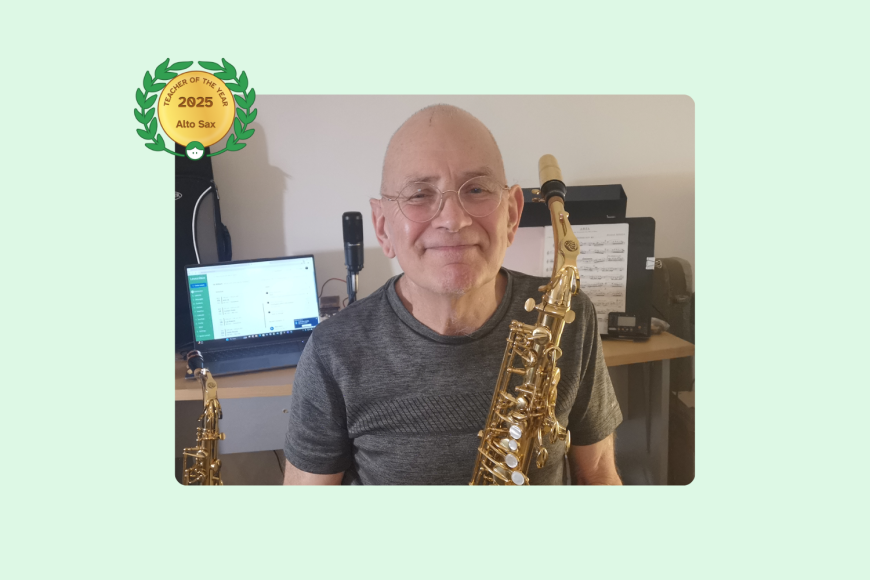

We asked 2025 Lessonface Teacher of the Year in Alto Sax, Willem Moolenbeek, to share insights into his journey as a musician and educator. In this Q&A, he reflects on what first drew him to the alto saxophone, how he structures his teaching and learning environment, and the key skills and habits he emphasizes for student growth. He also discusses the tools and resources he relies on, offers guidance on goal-setting and practice, and shares thoughts on personal and student accomplishments. Finally, he looks ahead to new ideas, techniques, and projects he’s excited to explore in the coming year, offering insights from the perspective of a lifelong performer and teacher.
What drew you to learning the saxophone? Why do you think it is popular (or perhaps should be more popular)?
I played harmonica and recorder in my high school folk club. Two of the group were singer guitarists who wrote songs. One of them had an old saxophone in the house that I borrowed and badly taught myself to play. The folk singing morphed into rock music and I found a saxophone teacher who had already made twenty albums. I stuck with the two singer guitarists and we recorded many of their pieces. The teacher was focused on concert style music eventually recording 65 albums. He started the saxophone program of Canada’s Royal Conservatory of Music from which I graduated and that secured my love for concert saxophone and teaching the instrument.
How would you describe your teaching studio?
My location varies depending on the season and my travel needs. I try to set up my space in the same manner wherever I am. I like to sit at a desk, facing a wall with my laptop in front of me, a USB mic to the right and a desktop music stand beside it. My saxophones are in easy reach to my left. I prefer to teach with over the ear headphones.
How do you ensure you are a good mind frame for teaching in terms of your teaching space?
I start my day with a look at my schedule and set an alarm to notify me 10 minutes prior to each lesson. That gives me time to get to my desk and open the file with notes of what the student is working on. If the pieces are on the computer I get them ready to view onscreen and those that are print versions I put on the desk stand. My portfolio of teaching materials travels with me wherever I go.
If you could gift your students one piece of automatic knowledge or ability about the Alto Sax, what would it be?
To be a good player you need to be a good listener. Music is an aural art. Immerse yourself in the art form. Listen actively, not just as background sound. Attend concerts. While a great deal of enjoyment comes from playing the instrument, in practicing, playing with bandmates and friends, developing musicianship includes listening. We are living in an era where listening to historical and current performances has never been easier.
What’s one lasting takeaway you hope your students will carry with them from your teaching, even years from now?
Great Sound is Job Number One. My teacher said to me: “You might play like you have ten fingers on each hand, and tongue like a rattlesnake, but if you don’t sound good, nobody will care!”
What are some of your most indispensable pieces of gear?
There are many mouthpiece and reed options. If the instrument is mechanically sound a top quality mouthpiece, matched with the appropriate reed is needed. I am a fan of Vandoren reeds and mouthpieces. A metronome and tuner app on the phone or as separate pieces of gear are indispensable.
What are some gear items that you wish all your students had?
In addition to the above, a serious student should have a USB mic and a camera that allows me to see more of the instrument so that I can see posture and how the hands and fingers are moving.
Are there apps / texts / other resources you often recommend?
I start all my students on the Rubank saxophone method series to develop basic techniques. They are inexpensive and readily available.
Anything new that came out this past year or you are anticipating in 2026?
As a Jupiter saxophone clinician for over 20 years I was delighted to spend time with the new JAS 1150 alto which I played and made a video about. It will be officially released in January 2026. It’s a terrific horn and will be much appreciated.
What’s a skill or idea you’re excited to explore in 2026?
I practice the chromatic harmonica. Many techniques of breath control and articulation that I use on the saxophone lend themselves to that instrument. Plus you can play it quietly! I continue to explore a wonderful Canadian program: Band in a Box that I use to make accompaniment tracks for myself and students. Each year there is an upgrade and it just keeps getting better.
Anything you’d like to share about yours or your students' accomplishments from 2025?
Every year I have students who bring music which they must prepare for auditions. This narrows down the focus for part of the lessons. Wanting to win the audition is an excellent incentive to practice and I had a couple that successfully did that this fall.
Do you have guidance for goal-setting for students of Alto Sax, or generally?
As was noted above, if you put yourself in a position that requires you to work harder to get a job done; you will succeed.
If you are interested in learning more about Willem or would like to book a lesson with him, please visit his Lessonface profile here.
Also, be sure to check out all of Lessonface’s 2025 Teachers of the Year here!

Start Lessons
Search for your perfect music, language, or arts teacher and start working towards your learning goals.
Start with a Free Trial
Teachers on Lessonface set their own rates and discounts. Participating teachers offer free trials.
Great Teachers, Great Lessons, Guaranteed
Learn more about the greatest universe for online music and arts lessons.

Lessonface Recitals, Open Mics, Masterclasses, and Jams
Welcome students of all ages and skill levels!